
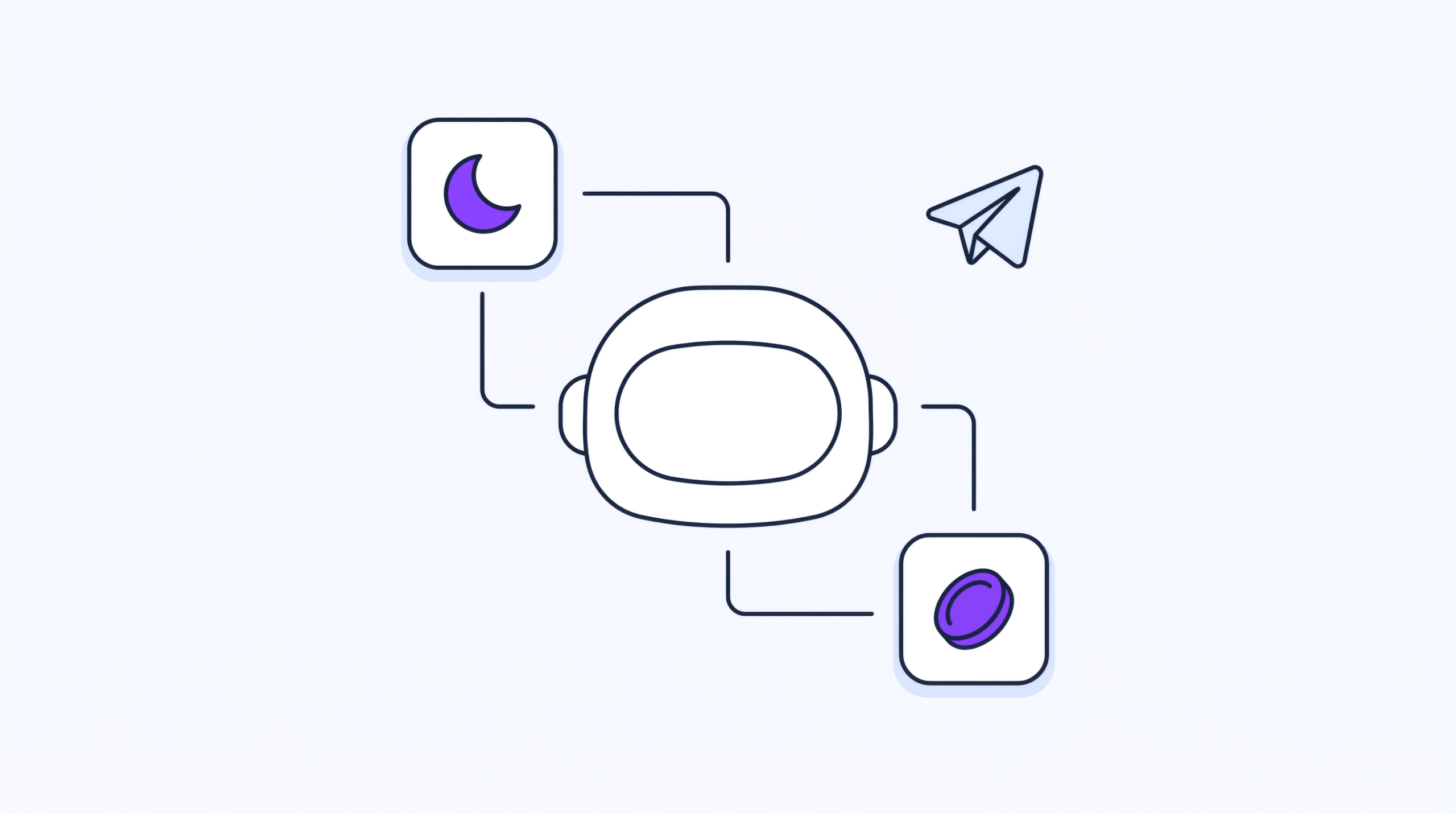
MoonPay has extended its MoonAgents AI assistant to Telegram, giving users a way to run crypto market analysis and prepare transactions from their phone without opening the desktop app, according to CoinMarketCap. The move turns Telegram into a mobile front-end for a tool that previously only lived on desktop — and it’s a useful case study in how crypto-focused AI agents are starting to treat Telegram as an access layer rather than a standalone product.
What actually launched
MoonAgents first shipped as a desktop app in June, letting users connect AI models — including Anthropic’s Claude Code and OpenAI’s Codex — to crypto wallets, token swaps, prediction markets, and other blockchain services. The Telegram version doesn’t replace that desktop core; it sits on top of it. Users create a personal bot through Telegram’s BotFather and link it to their existing desktop installation, after which the bot accepts plain natural-language instructions: analyze a token, build a monitoring dashboard, prepare a transaction, or track activity across chains.
Per MoonPay’s Agents Product Lead Kevin Arifin, the integration was built specifically to close the gap between full desktop access and needing to check or act on something while away from a computer.
Why Telegram, specifically
Arifin’s stated reasoning lines up with something we’ve covered before on this site: Telegram’s bot setup is dramatically lower-friction than the alternatives. Creating a bot through BotFather takes minutes, while comparable integrations on WhatsApp or iMessage require more configuration overhead before a similar connection works. Notably, Arifin said Telegram’s popularity within the crypto industry was a secondary factor in the decision — the technical simplicity of the integration came first. That’s consistent with the broader pattern across our Crypto AI category: tools tend to launch on Telegram not because of hype, but because the bot infrastructure genuinely requires less engineering to ship something usable quickly.
The data-handling detail worth noting
One design choice stands out against the backdrop of what we’ve written about what “free” AI tools actually cost you in terms of data: MoonAgents is structured so Telegram acts only as a messaging layer. Conversations, account data, and private keys stay stored locally on the user’s own computer rather than on Telegram’s servers. Arifin noted that even if Telegram disappeared entirely, users could keep using their agent through the desktop app with prior conversation history intact.
This is a meaningfully different architecture from most Telegram AI bots, which typically run server-side and store at least some conversation state remotely. Whether that local-first design becomes more common across other crypto AI tools on Telegram — or stays a MoonPay-specific choice — is worth watching, especially for a category where wallet access and financial data are directly on the line.
Part of a wider pattern in agentic crypto tools
MoonAgents isn’t launching into a vacuum. Arifin pointed to AI agent projects OpenClaw and Hermes Agent as direct influences on the product’s design — OpenClaw in particular, he said, reset expectations for what a language-model interface should be able to do once models could operate directly on a local machine.
The broader industry is moving in the same direction: Gemini launched Agentic Trading in April, connecting models like ChatGPT and Claude to its exchange for executing trading strategies, and Coinbase shipped Coinbase for Agents in June, letting AI agents trade and manage portfolios within limits the user defines. Nous Research also converted Hermes Agent from a command-line tool into a standalone desktop app the same month. Crypto-native AI agents that can act — not just answer questions — are becoming the default expectation rather than the exception, and Telegram is emerging as a common distribution point for several of them at once.
What this means if you’re evaluating crypto AI bots on Telegram
A few practical takeaways from this launch, relevant beyond just MoonPay’s tool:
- “Runs on Telegram” doesn’t always mean “hosted on Telegram.” As this integration shows, some bots use Telegram purely as a chat interface while keeping sensitive data elsewhere — worth checking which model any crypto tool you use is actually built on, since the privacy implications differ significantly.
- Wallet-connected agents are becoming more common, not less. If you’re browsing Crypto AI tools in this directory, expect more of them to request real transaction-level permissions going forward, which makes checking exactly what a bot is authorized to do more important, not less.
- The underlying AI model matters. Tools built to work with multiple models (Claude, GPT, or others) rather than one proprietary model tend to give users more flexibility — and sometimes more transparency — about what’s actually processing their data.
We’ll keep tracking how this integration performs and whether similar local-first, Telegram-as-access-layer designs show up elsewhere in the Crypto AI category. For more on how to evaluate a crypto AI bot before connecting a wallet to it, see our breakdown of what free AI tools actually cost you.